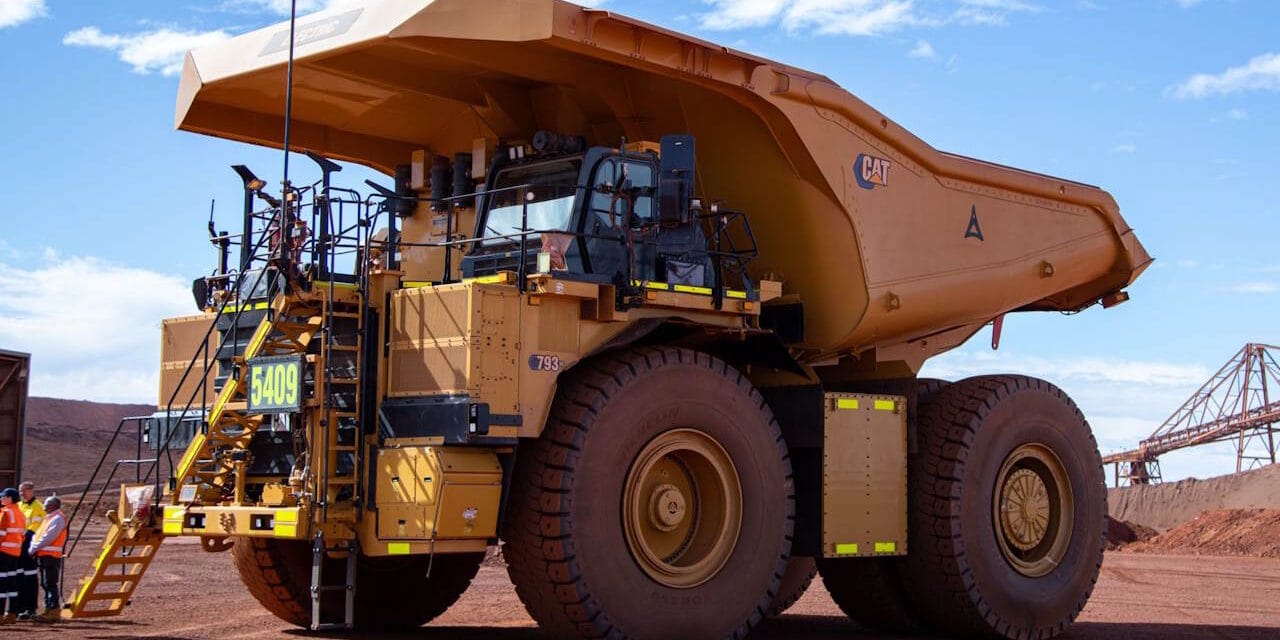
BHP, Rio Tinto and Caterpillar Progress Battery-Electric Haul Truck Trials at Jimblebar Mine
BHP, Rio Tinto and Caterpillar Advance Battery-Electric Cat 793 XE Haul Truck Trials in Major Mining Decarbonisation Push
BHP, Rio Tinto and Caterpillar have reported early progress in their joint trial of two Cat 793 XE Early Learner battery-electric haul trucks at BHP’s Jimblebar iron ore mine in Western Australia.
The trucks were initially tested at Caterpillar’s Tucson Proving Ground in the United States, where they completed safety validation and controlled trials before being deployed to Jimblebar.
Since arriving on site, they have completed more than 100 hours of operation and over 200 test laps following three months of field testing.
According to the companies, the trial is already delivering valuable operational data to assess the technical readiness, infrastructure requirements and commercial viability of large-scale battery-electric haulage in mining.
The next phase will focus on dynamic charging technology, which allows trucks to recharge while in motion through an energy transfer system.
If successful, this approach could significantly improve operational efficiency and reduce downtime.
The Cat 793 XE, a 240-tonne class haul truck, represents one of the most ambitious attempts to electrify large-scale mining fleets.
Most existing battery-electric deployments globally are concentrated in smaller trucks operating in less energy-intensive environments.
The trial is part of a broader industry effort to decarbonise mining operations. According to the International Council on Mining and Metals (ICMM), around 28,000 large haul trucks operate globally, consuming approximately 25 billion litres of diesel annually and producing more than 69 million tonnes of CO₂.
Within this context, electrifying haul fleets is seen as a critical pathway toward reducing emissions, particularly Scope 1 emissions, which remain heavily dependent on diesel-powered equipment.
BHP Australia President Geraldine Slattery said the trial is central to the company’s decarbonisation strategy, helping to better understand how battery-electric systems can be scaled safely and efficiently across operations, including energy management and charging infrastructure.
Rio Tinto Iron Ore CEO Matthew Holcz noted that real-world testing in the Pilbara’s demanding conditions is essential for generating practical insights needed for large-scale deployment.
Caterpillar Vice President of Product Management for Resource Industries Thad Litkenhus added that collaboration in operational environments is accelerating the development of battery-electric solutions that can be deployed with confidence.
The Jimblebar site hosts two of seven Cat 793 XE Early Learner trucks currently being tested globally.
The initiative is part of a wider electrification push across BHP’s Australian operations, which also includes battery-electric locomotive trials with Wabtec and Progress Rail in the Pilbara region.
These programs aim to better understand how high-energy battery systems perform in both mining and rail applications.
BHP has already reported a 36% reduction in operational greenhouse gas emissions against its 2020 baseline, driven largely by increased use of renewable electricity. Diesel, however, remains its largest source of operational emissions.
Industry stakeholders say the transition from controlled trials to full operational deployment will be the key test for battery-electric haulage at scale in heavy mining environments.